The new Fred Young Submillimeter Telescope (FYST), operated by CCAT Observatory, Inc., has passed another major milestone: On November 4, 2026, CPI Vertex Antennentechnik GmbH, the German contractor building FYST, officially turned over control of the telescope’s motion to the CCAT team. This lets CCAT assume operational responsibility for the telescope and begin testing and calibration work early, while the remaining finishing work wraps up in parallel.
“This is another example of the excellent relation we have with CPI Vertex, and shows how we are more like partners in this project instead of the classic customer/vendor relationship. By giving us operational control, we can advance the calibration work that can only be done by the Observatory and not have to wait for the telescope construction to wrap up by the end of this year,” said Stephen Parshley, FYST chief of engineering and operations.
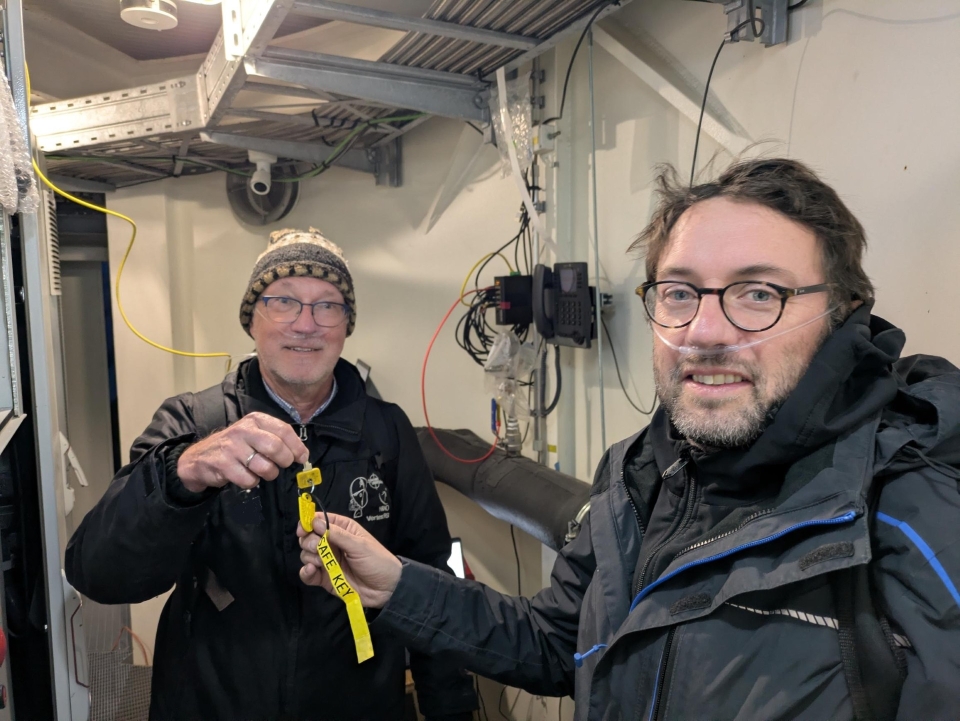
“The handover of the control key is the culmination of ten years of effort,” said FYST Deputy CEO Dr. Ronan Higgins, research scientist at the University of Cologne. “We’re looking forward to putting the telescope to work in the coming months. It is particularly symbolic to receive the control key from Klaus Willmeroth at CPI Vertex, who has stayed on through retirement to bring the project to a conclusion.”
The telescope’s six-meter mirrors and innovative optical design will offer a high-throughput, wide-field of view observatory capable of mapping the sky rapidly and efficiently. Located at extreme altitude, 5,600 meters above sea level, the exceptionally high and dry location in Chile’s Parque Astronómico Atacama (Atacama Astronomical Park) in the Atacama Desert is uniquely suited to enable scientists to answer fundamental questions about how the universe works and how it evolves.
The telescope was designed by CPI Vertex in Duisburg, Germany and test assembled in Xanten, Germany on the Wessel GmbH premises. FYST, about the size of a five-story building, was then carefully disassembled and transported by truck, barge and ship to Chile, a complex transport orchestrated by Vertex. Its major sections weighed 35 to 55 tons each.
A consortium of the Universities of Cologne and Bonn is closely involved in the new telescope. One of the first two instruments to be installed in FYST will be mini-CHAI, which was designed and built at the University of Cologne. It is a high-resolution spectrometer and precursor of the full-size CCAT Heterodyne Array Instrument (CHAI). “After boxing up the instrument components and sending it on its way over the past few months, we now strongly anticipate to install it in its intended habitat in the heart of FYST and measuring a first spectrum. This major milestone in the project brings us a critical step closer to demonstrating the unique capabilities of the facility,” said Prof. Dr. Dominik Riechers, lead of the group at the University of Cologne and Managing Director of Dynaverse.
Mini-CHAI arrives on site in November, according to scientists at the University of Cologne. “Now comes a particularly exciting phase for us: we can install mini-CHAI in FYST and finally put it to work. It will allow astronomers to survey large areas of the sky and capture the spectral fingerprints of atoms and molecules with great precision,” said Dr. Marc Mertens, research scientist at the University of Cologne.
The other of the first two instruments in FYST will be Prime-Cam, which has seven instrument modules with three detector arrays per module. Prime-Cam’s test fitting began in August, according to Michael Niemack, professor of physics and astronomy at Cornell University and leader of the Prime-Cam team. “We’re excited to return to Chile, integrate Prime-Cam with FYST for the first time, and use them together for new astronomical measurements,” Niemack said.
The CCAT Observatory operates the Fred Young Submillimeter Telescope under a partnership of Cornell University, a German consortium consisting of the University of Cologne, the University of Bonn and the Max Planck Institute for Astrophysics, a consortium of eight Canadian universities led by the University of Waterloo, and Duke University. CCAT operates in Chile under a cooperative agreement with the University of Chile and under the auspices of the Ministry of Foreign Affairs.
Photo: Ronan Higgins
Text: Jonas Zerweck
Originally published on the SFB 1601 website.